Getting recruited for men’s college volleyball takes more than playing well and hoping a coach notices you.
For Canadian athletes targeting U.S. colleges, the process usually involves researching programs, understanding where you realistically fit, creating strong recruiting materials, contacting coaches directly and staying visible throughout your recruiting years.
Men’s volleyball also has a different college landscape from women’s volleyball. There are fewer programs, scholarship structures vary by division and school, and roster needs can change quickly based on position and graduation year.
The athletes who give themselves the best chance are usually the ones who start early, target programs strategically and make it easy for coaches to evaluate them.
Article Summary
- Canadian men’s volleyball players can be recruited by NCAA and NAIA programs in the United States.
- Do not wait to be discovered. Build a realistic school list, create a recruiting profile and video, and contact coaches directly.
- Coaches evaluate technical ability, position, physical tools, academics, development potential and whether they actually need a player like you.
- Height can matter in men’s volleyball, especially at certain positions, but there is no universal height requirement for playing college volleyball.
- Scholarship opportunities vary significantly by NCAA division, NAIA program and school budget.
- A proposed U.S. bill would limit international athletes to 20% of each varsity roster at covered institutions beginning in 2029–30 if enacted. As of September 2026, this is proposed legislation and is not current law.
In This Guide
- How Men’s College Volleyball Recruiting Works
- Where Can Men’s Volleyball Players Compete in College?
- When Should You Start Recruiting?
- What Do Men’s College Volleyball Coaches Look For?
- Does Height Matter in Men’s College Volleyball Recruiting?
- How to Make a Men’s Volleyball Recruiting Video
- How to Contact College Volleyball Coaches
- Using Tournaments, Camps and Showcases
- Men’s Volleyball Scholarships and Financial Aid
- What Canadian Athletes Need to Know
- Possible Future International-Athlete Roster Limits
- Common Men’s Volleyball Recruiting Mistakes
- Frequently Asked Questions
- Final Thoughts
How Men’s College Volleyball Recruiting Works
College volleyball recruiting is usually a process rather than one moment when an athlete gets discovered.
A coach may first learn about you through a recruiting email, tournament, club coach, showcase, recruiting profile or video. From there, the coach may watch more footage, follow your results, speak with your club coach, review your academics and evaluate whether your position fits the program’s future needs.
This is why waiting to be scouted can be risky.
A better approach is to actively identify programs that fit your level and make yourself visible to those coaches.
Our step-by-step guide on how to get recruited for college volleyball explains the broader recruiting process in more detail.
Where Can Men’s Volleyball Players Compete in College?
Canadian athletes should look beyond only the most recognizable NCAA Division I programs.
Men’s college volleyball opportunities exist across NCAA programs and the NAIA, with different competitive levels, academic environments and financial-aid structures.
The NCAA currently operates a National Collegiate Men’s Volleyball Championship as well as a separate Division III Men’s Volleyball Championship. Men’s volleyball continues to expand, and the NCAA Division II membership is also considering the creation of a separate Division II championship in the future.
The NAIA also sponsors men’s volleyball and describes it as a growing college sport with athletic scholarship and recruiting opportunities.
That means athletes should build a school list based on fit, not simply division labels.
Consider:
- Volleyball level
- Your position and the program’s roster needs
- Academics
- School size and location
- Playing opportunity
- Cost and financial aid
- Coaching style
- Your long-term goals
When Should Men’s Volleyball Players Start Recruiting?
You do not need to wait until Grade 12 to begin.
Start by learning how the recruiting process works, researching schools and collecting video before you are under pressure to make decisions.
As you develop, your recruiting materials can become more detailed and your school list more focused.
The goal is not to send hundreds of emails as early as possible. The goal is to be prepared when your level, video and academics give coaches enough information to evaluate you.
Starting early also gives you time to adjust your target list if the first schools you contact are not showing interest.
What Do Men’s College Volleyball Coaches Look For?
College coaches are evaluating more than whether you can hit hard or jump high.
They are trying to answer a more important question:
Can this athlete help our program?
That evaluation can include:
- Technical skill
- Consistency
- Volleyball IQ
- Position-specific ability
- Physical development
- Serving
- Blocking and defence
- Communication
- Academic fit
- Potential for improvement
- Team and roster needs
Setters
Coaches may evaluate setting location, tempo, decision-making, movement, out-of-system ability, serving, blocking, defence and communication.
Outside Hitters and Opposites
Evaluation may include attacking range, efficiency, serving, blocking, transition ability and, for outside hitters, serve receive and ball control.
Middle Blockers
Coaches may focus on lateral movement, blocking timing, transition speed, quick-attack ability, serving and physical reach.
Liberos and Defensive Specialists
Serve receive, defensive range, ball control, serving, reading the game and communication become particularly important.
The exact priorities differ by coach and program, which is another reason not to judge your recruiting level based on one measurement alone.
Does Height Matter in Men’s College Volleyball Recruiting?
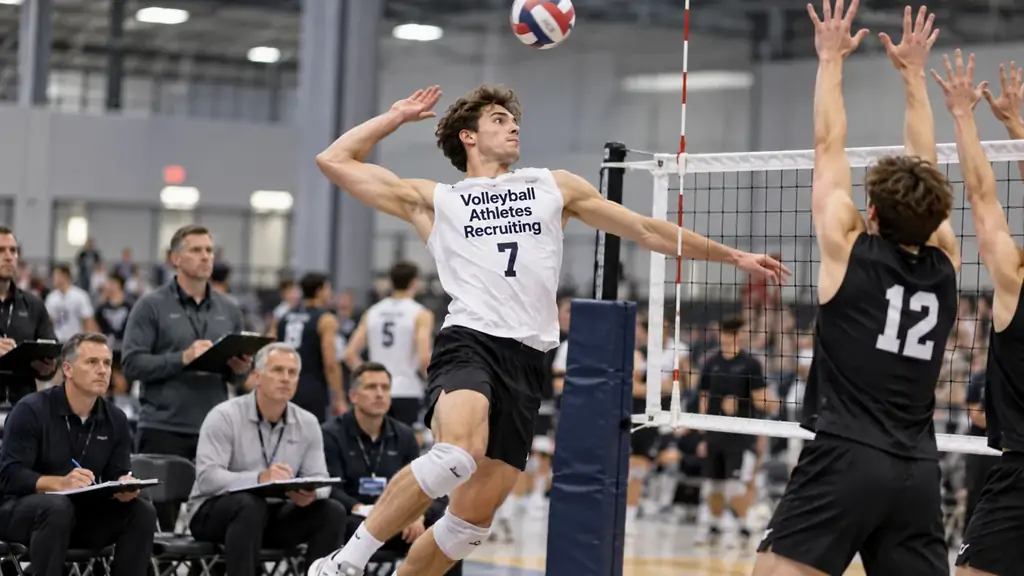
Yes, height and reach can matter in men’s volleyball, particularly at positions where blocking and attacking above the net are major parts of the role.
But there is no universal height requirement that determines whether you can play college volleyball.
Different programs recruit at different levels, and coaches also consider athleticism, jumping ability, speed, technique, ball control and development potential.
A shorter athlete with elite skills and the right positional fit may have opportunities that a taller athlete with weaker fundamentals does not.
Instead of asking only, “Am I tall enough?”, ask:
“Which programs match my complete athletic profile?”
How to Make a Men’s Volleyball Recruiting Video
Your recruiting video should help a coach evaluate you quickly.
Do not begin with a long introduction, dramatic effects or several minutes of unrelated footage.
Make it immediately clear who you are and show your strongest position-specific skills early.
A setter’s video should not look the same as a middle blocker’s video. A libero needs to demonstrate different skills than an opposite.
Good recruiting footage should also make it easy to identify you on the court and should be supported by full-game footage when a coach wants a deeper evaluation.
For the complete process, read our guide on how to make a volleyball recruiting video, including video length, clip order and position-specific footage.
Your video should also be connected to a complete volleyball recruiting profile containing your academic information, position, graduation year, club details and contact information.
How to Contact Men’s College Volleyball Coaches
Do not make coaches search for the basic information they need.
Your initial message should be short and professional.
Include:
- Your name
- Graduation year
- Position
- Height and relevant measurements
- Club and team
- Academic information
- Recruiting-profile link
- Video
- Upcoming tournament schedule when relevant
Most importantly, contact schools that make sense for you.
Sending 200 identical emails is not necessarily better than sending a smaller number of well-targeted messages to coaches whose programs match your academic and athletic level.
If a coach does not respond, follow up when you have useful new information rather than repeatedly sending the same message.
How to Use Tournaments, Camps and Showcases for Recruiting
Tournaments and showcases become much more useful when coaches already know who you are.
Before an event, contact relevant programs and tell coaches where you will be playing.
Give them your court, schedule and recruiting profile when that information is available.
This turns the event from:
“I hope someone sees me.”
into:
“Coaches who may already be interested know exactly where to find me.”
Before spending heavily on a recruiting event, read our guide explaining whether volleyball recruiting showcases and combines are worth it.
Men’s Volleyball Scholarships and Financial Aid
Scholarship opportunities vary considerably by division and school.
At NCAA Division I institutions covered by or opting into the House settlement, men’s volleyball currently has an 18-player roster limit. Those schools are no longer restricted by the old sport-specific scholarship cap and can provide athletics scholarships across the roster, although they are not required to fully fund every player.
NCAA Division II currently uses an equivalency model with a maximum of 4.5 men’s volleyball scholarship equivalencies. Coaches can divide available aid among multiple athletes.
NCAA Division III schools do not award athletic scholarships, although athletes may receive academic, merit-based or need-based financial aid.
NAIA schools may also provide athletics and academic aid, with the institution determining the individual package within NAIA financial-aid rules.
For a complete breakdown, read our guide on how to get a volleyball scholarship as a Canadian athlete.
What Canadian Men’s Volleyball Players Need to Know About U.S. Eligibility
Canadian athletes recruiting to U.S. programs also need to complete the appropriate eligibility process.
International athletes planning to compete in NCAA Division I or II generally need academic and athletics certification through the NCAA Eligibility Center. International Division III athletes generally need athletics certification as well.
The NCAA provides country-specific academic information for Canada through its international student-athlete eligibility resources.
For NAIA programs, first-time athletes must register through the NAIA Eligibility Center, and international students may also need credential evaluation through InCred. The NAIA international student-athlete page explains the current process.
Do not leave eligibility paperwork until the end of recruiting. A coach may be interested in you, but you still need to satisfy the school’s admissions and athletic eligibility requirements.
Could Future International-Athlete Limits Affect Canadian Men’s Volleyball Players?
Canadian recruits, particularly athletes planning to enter college in 2029 or later, should also monitor a recent U.S. legislative proposal.
On September 14, 2026, H.R. 10351, the Training and Education for American Members in University Sports and Athletics Act (TEAM USA Act), was introduced in Congress.
As proposed, it would require colleges and universities participating in federal Title IV student-aid programs to limit international student-athletes to no more than 20% of each varsity team’s roster. The proposal states that the requirement would begin with the 2029–30 academic year.
The proposed 20% limit is not current law and is not currently an NCAA recruiting rule.
Canadian athletes should therefore continue recruiting under the rules currently in effect. However, athletes whose college years could fall under the proposed implementation period should monitor whether the legislation advances or changes.
You can read the official U.S. House Education and Workforce Committee announcement.
Regardless of whether the proposal becomes law, building a broad list of realistic programs is good recruiting practice. Depending entirely on one or two schools leaves an athlete vulnerable to coaching changes, roster changes and shifts in recruiting priorities.
Common Men’s Volleyball Recruiting Mistakes
Waiting to Be Discovered
Playing at strong tournaments helps, but coaches cannot recruit you if they do not know who you are.
Only Contacting Major NCAA Programs
A recognizable school name does not automatically make it the right athletic or academic fit.
Using Weak or Outdated Video
Make sure coaches can see your current ability and easily identify you.
Ignoring Academics
Athletic ability cannot compensate for every admissions or eligibility problem.
Starting Too Late
Programs recruit by position and graduation class. Waiting until most programs have already addressed their roster needs can significantly reduce your options.
Assuming No Reply Means the Process Is Over
Coaches may be recruiting another graduation year, travelling or waiting for additional evaluation. Continue developing multiple realistic opportunities.
Frequently Asked Questions About Men’s College Volleyball Recruiting
How do I become a Division I men’s volleyball player?
There is no single checklist that guarantees Division I recruitment. Athletes need to demonstrate a level that fits the program, satisfy academic and eligibility requirements and match a roster need. Strong video, direct coach contact and realistic school targeting all improve your chances of being evaluated.
What colleges have men’s volleyball?
Men’s volleyball programs exist across NCAA and NAIA institutions. Because programs and affiliations can change, use current NCAA and NAIA program directories rather than relying on an old static list.
Can Canadian men’s volleyball players get U.S. scholarships?
Yes. Canadian athletes can receive athletic aid from eligible U.S. programs when they meet the applicable recruiting, admissions and eligibility requirements. The amount varies by school, division and recruiting need.
How tall do you need to be to play men’s college volleyball?
There is no universal minimum height. Height and reach may matter more at some positions and levels, but skill, athleticism, position, jumping ability and program fit are also important.
Do I need to attend showcases to get recruited?
No. Showcases are one recruiting tool. Direct coach outreach, club tournaments, recruiting video, camps and recruiting profiles can also create opportunities.
Can I manage men’s volleyball recruiting myself?
Yes. Families can manage research, video, emails and follow-up themselves if they have the time and knowledge to manage the process consistently. Others choose professional recruiting support to help with school targeting and coach outreach.
Final Thoughts: Give Coaches a Reason to Recruit You
Men’s college volleyball recruiting is not simply about being the best athlete in the gym.
You need to find programs where your position, athletic ability, academics and graduation year solve a recruiting need.
Build your school list carefully, create strong recruiting materials, contact coaches directly and keep developing multiple options.
If your family wants to handle recruiting independently, compare the different volleyball recruiting options available to Canadian athletes.
If you want support identifying appropriate programs, contacting coaches and managing the U.S. recruiting process, learn more about our U.S. volleyball recruiting services for Canadian athletes.