How to Get Recruited for College Volleyball in Canada, without the help of an agency – The DIY version
Click here to download the checklist for an easier comparison.
Table of Contents
Why Canadian Volleyball Recruiting Can Be Done by Yourself

Now, let’s get into ‘How to’ do it.
Step 1: Create a List of Schools. Research Canadian Universities/Colleges With Volleyball Programs
The first step is to decide where you want to study and play. Make a list of universities and colleges in Canada that have volleyball programs.
- Research their academic programs to ensure they match your career goals.
- Check team performance, league level (U SPORTS Conferences and Members list, CCAA Conferences and Members), and roster needs.
- Consider location, campus size, tuition costs, and scholarship availability.
This list will be the foundation of your recruiting journey.
Step 2: Establish Criteria for Decision-Making
Not all schools will be the right fit for you. Separate your criteria into must-have and good-to-have factors. Think about what is important for you to make the post-secondary years a great experience.
Must-have examples:
- Preferred academic program
- Competitive level that matches your skill set
- Location you can realistically move to
Good-to-have examples:
- Athletic scholarships or financial support
- Strong facilities and athletic support staff
- A winning or competitive program
Having clear priorities makes the decision easier once you start receiving interest.
Here is a very useful article about how to approach the school selection process.
Step 3: Find Coaches and Contact Information

Almost every university or college team in Canada has a dedicated athletics website. Visit the volleyball team’s page to:
- Identify the head coach and assistant coaches
- Collect their email addresses and phone numbers. Build a contact spreadsheet to track your progress
- Review recent news, rosters, and announcements
Keep this information in a spreadsheet alongside your school list so you can stay organized.
Step 4: Build a Strong Recruiting Profile Page

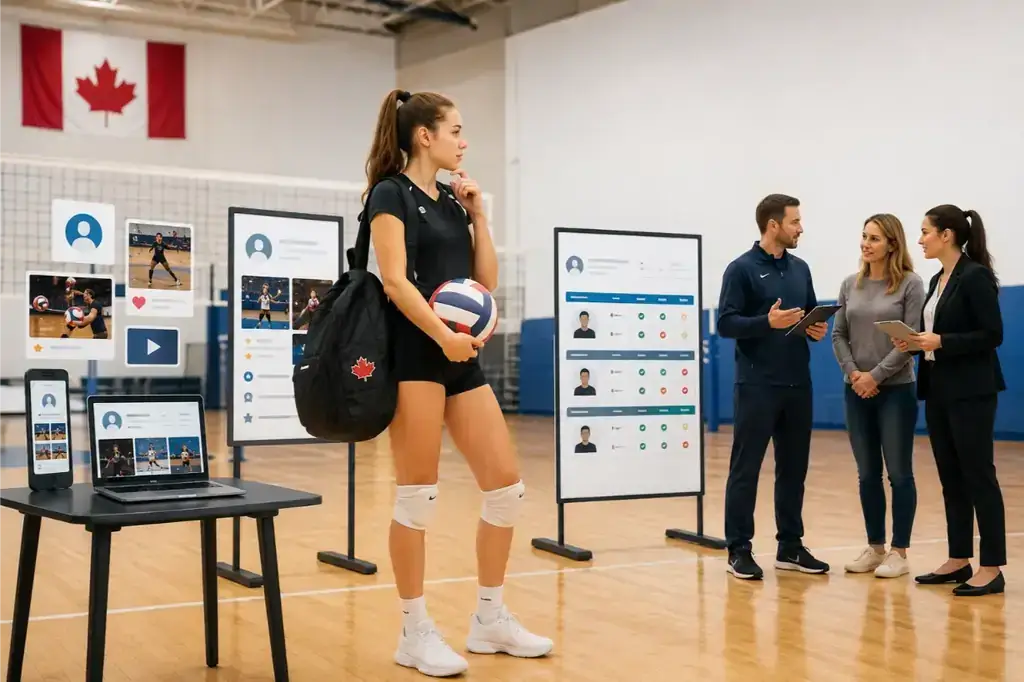
Your recruiting profile is your digital resume as a volleyball athlete. Coaches should be able to find all the key details about you in one place and find them easily and fast.
Your page should include:
- Full name, graduation year, position, height, reach, and physical stats
- Academic information: GPA, major interest
- Highlight videos and full game footage
- Athletic achievements, awards, and club team info
- Upcoming tournament schedule
Tip: Volleyball Recruiting Websites like Volleyball Athletes allow you to create a searchable profile that coaches can access easily. Check an example of a volleyball profile page here.
The Volleyball Athletes pages were designed with the needs of a recruiting coach in mind.
Step 5: Write Professional emails to Volleyball Coaches
Introduce yourself to coaches with a personalized email. Include:
- Who you are and what position you play
- Why are you interested in their program and school
- A link to your Volleyball Athletes recruiting profile page
- Highlight videos or YouTube links
- Your upcoming tournament schedule
Here are a few examples of Subject Lines, highlighting important information or qualities:
- Mary Jane 2027 setter, All Canadian 2025, 16U National Champion
- Mark Doe 2028 6’5” outside hitter
Keep your message simple, concise and professional. Coaches receive many emails. Don’t ask them to spend 10 minutes reading your email.
Check more best practices for writing recruiting emails here.
Top Mistakes to Avoid When Contacting Coaches in Canada
Sending Generic Emails
- Copy-paste messages with no mention of the school name or program show a lack of effort.
- Coaches want to know why their program is the right fit for you.
Forgetting to Include Position and Graduation Year
- A coach shouldn’t have to dig through your email to know if you’re a 2026 Setter or 2027 Outside Hitter.
- Always put your position, height, grad year in the subject line and first paragraph.
Not Adding a Recruiting Profile Link
- Without a link to your Volleyball Athletes recruiting profile (or similar page), coaches have no quick way to see your stats, academic info, and videos.
- Don’t attach huge files — always link.
Writing Long, Overwhelming Emails
- Coaches are busy; they scan.
- Keep messages short, clear, and professional — then attach or link to more details.
Poor or Unprofessional Email Addresses
- Sending from volleyballqueen123@… looks unprofessional.
- Use a simple format: firstname.lastname@gmail.com.
Not Proofreading
- Spelling mistakes, wrong coach names, or confusing sentences make a bad first impression.
- Always double-check grammar and school names before sending.
- Do not be too casual or informal.
Contacting Too Late in the Process
- Waiting until Grade 12 to start emailing drastically reduces opportunities
- Start early (Grade 10–11) to build relationships and stay on the radar.
Being Pushy or Impatient
- Coaches appreciate persistence but not daily emails asking, “Did you watch my video?”
- Send updates when you have something new — a highlight reel, tournament schedule, or academic achievement.
Ignoring Academic Information
In Canada, academics are just as important as athletic ability.
Forgetting to Follow Up
- One email is not enough.
- If you don’t follow up with updates, coaches may forget about you — consistency matters.
Disregard Social Media
Before contacting coaches, review your social media to ensure your online presence is professional and doesn’t contain anything that could jeopardize your integrity.
These mistakes are common but easy to avoid with preparation. Coaches notice athletes who are professional, respectful, and organized in their communication.
Maximizing Your Volleyball Athletes Recruiting Profile
Final Thoughts
Learning how to get recruited for volleyball in Canada when DIY takes time and discipline, but it’s absolutely achievable. By researching schools, contacting coaches, maintaining a professional online profile, and providing regular updates, you’ll put yourself in a strong position to be noticed.
Remember, coaches are always looking for athletes who are not only talented but also organized, proactive, and passionate about both their sport and academics.
If you’re interested in managing the recruiting process on your own and would like to play in the NCAA, here is an All Canadian Recruiting app you can use or you can use our volleyball recruiting profile pages.