Your volleyball recruiting video may be one of the first things a college coach uses to decide whether they want to learn more about you.
That does not mean you need expensive equipment, dramatic editing or a professionally produced sports movie.
You need something much simpler: clear footage that makes it easy for a coach to identify you and evaluate the skills that matter for your position.
I have watched many recruiting videos, created highlight reels and listened to recruiting coaches explain what they want to see. One of the biggest mistakes athletes make is trying to impress coaches with editing instead of helping coaches evaluate their volleyball.
The best recruiting video is usually simple, short and focused.
Article Summary
- A volleyball recruiting video should usually be approximately 3–5 minutes for an initial evaluation.
- Put your strongest and most position-relevant clips near the beginning.
- Clearly identify the athlete before each sequence when necessary, but avoid distracting graphics, music and effects.
- Show several repetitions of the skills coaches need to evaluate for your position.
- Keep full-game footage available separately because interested coaches may want to see more than highlights.
- Your video should connect to a complete recruiting profile containing your academics, physical information, club history, schedule and contact information.
- Update your video as you develop instead of relying on one highlight reel throughout your entire recruiting process.
In This Guide
- How Long Should a Volleyball Recruiting Video Be?
- Highlight Video vs. Recruiting Video vs. Full-Game Footage
- How to Make a Volleyball Recruiting Video Step by Step
- What Clips Should You Include by Position?
- What Should You NOT Put in a Recruiting Video?
- Should You Add Music, Slow Motion, Arrows or Circles?
- How to Film Volleyball for Recruiting
- How to Use Your Video in Coach Emails and Your Profile
- When Should You Update Your Recruiting Video?
- What Canadian Athletes Should Keep in Mind
- Frequently Asked Questions
- Final Thoughts
How Long Should a Volleyball Recruiting Video Be?
For an initial recruiting video, I recommend aiming for approximately 3–5 minutes.
There is no NCAA rule requiring a specific recruiting-video length. The purpose is simply to give a college coach enough quality footage to determine whether they want to evaluate you further.
Longer is not automatically better.
If your best material can be shown in three minutes, do not stretch the video to five minutes by adding weaker clips.
Likewise, a coach should not have to watch eight or ten minutes before seeing your strongest plays.
The first portion of the video matters particularly because a coach who is evaluating many athletes needs to determine quickly whether your level may fit the program.
Show your best volleyball early.
If the coach is interested, you can provide additional clips or full-match footage.
Volleyball Highlight Video vs. Recruiting Video vs. Full-Game Footage
These terms are sometimes used interchangeably, but it is useful to think about two main types of footage.
Short Recruiting or Highlight Video
This is your initial evaluation video.
It should include selected clips demonstrating your strongest position-specific skills. The purpose is to help the coach determine quickly whether they want to continue evaluating you.
Full-Game Footage
Full matches give coaches more context.
A coach can see what happens between your best plays: movement, positioning, communication, consistency, decision-making and how you respond when the rally does not go perfectly.
You do not need to send a complete match in every first email.
Instead, make both options available. Start with the concise recruiting video and have full-game footage ready when a coach wants a deeper evaluation.
How to Make a Volleyball Recruiting Video Step by Step
1. Identify Yourself Immediately
A coach should not spend the first minute wondering which athlete they are supposed to watch.
At the beginning, include a short title screen with useful information such as:
- Name
- Graduation year
- Position
- Height
- Jersey number and colour
- Club/team
- Video date or season
Keep this screen short.
The coach opened the video to see you play, not to watch a presentation.
2. Put Your Strongest Plays First
Do not save your best clips for a dramatic ending.
Your opening clips should immediately show why a coach should keep watching.
Choose plays that demonstrate the skills most important for your position rather than simply the plays that received the loudest reaction from the crowd.
A spectacular save or attack may look impressive, but a coach is trying to evaluate whether your overall skill set fits college volleyball.
3. Show Multiple Repetitions of Important Skills
One perfect attack does not tell a coach whether you can consistently attack at that level.
Show several examples.
If you are a setter, show different locations and situations. If you are a libero, show serve receive and defence from different areas. If you are a hitter, show more than one type of attack.
The goal is to demonstrate repeatable ability, not create a collection of lucky moments.
4. Organize Clips Around Your Position
Do not randomly mix every volleyball skill you have ever performed.
Start with the actions most important to your position, then move toward secondary skills.
This makes the video much easier for coaches to evaluate.
5. Keep the Editing Simple
Recruiting video is not entertainment content.
You do not need dramatic transitions, animated titles or cinematic slow motion.
Simple cuts between clips are normally enough.
Every editing decision should answer one question:
Does this make it easier for the coach to evaluate me?
If the answer is no, you probably do not need it.
6. Keep Full-Game Footage Available
If a coach likes your recruiting video, they may want additional footage.
Have complete matches or sets available and organize them clearly so you can send them quickly.
Where practical, remove long dead periods such as time-outs or lengthy breaks, but do not edit the match in a way that removes the context a coach wants to evaluate.
7. Upload the Video Professionally
YouTube works well because coaches can open a simple link without downloading a large file.
Use a clear title such as:
Jane Smith | 2028 Setter | Volleyball Recruiting Video | Winter 2026
Check the link before sending it to coaches. Make sure the privacy settings allow them to view it.
Then add the video to your volleyball recruiting profile so coaches can access your video together with the rest of your recruiting information.
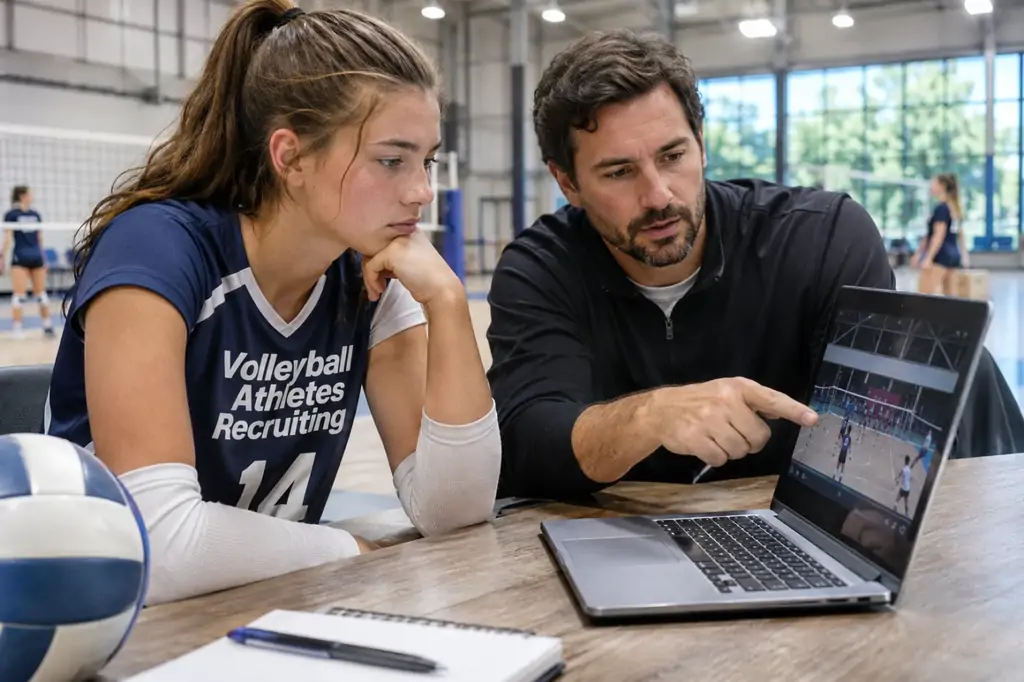
What Clips Should You Include by Volleyball Position?
Your video structure should change according to your position.
Outside Hitters
Consider including:
- Attacking from your primary position
- Different attack tempos
- Attacking from alternate positions
- Serve receive
- Passing from different back-row positions
- Blocking
- Defensive plays
- A few strong serves if time permits
Outside hitters need to demonstrate more than hitting because many college coaches are evaluating the athlete as a six-rotation player.
Opposite / Right-Side Hitters
Show:
- Attacking from the right side
- Blocking
- Transition attacks
- Back-row attacking where relevant
- Defensive plays
- Serving
Middle Blockers
Begin with the skills that are most important to your role:
- Blocking movement and timing
- Blocking followed by transition to attack
- Quick attacks
- Attacking in transition
- Movement across the net
- Serving if time permits
Make sure the camera angle allows the coach to see your footwork rather than only the final contact with the ball.
Setters
A setter’s video should show more than perfect passes leading to easy sets.
Include:
- Setting the middle
- Setting the left side
- Setting the right side
- Different tempos
- Out-of-system setting
- Movement to the ball
- Blocking
- Defence
- Attacking where relevant
- Serving
College coaches want to evaluate decision-making and consistency, not just hand contact.
Liberos and Defensive Specialists
Prioritize:
- Serve receive from multiple positions
- Defence from different areas
- Difficult-ball control
- Movement and reading
- Out-of-system setting where relevant
- Serving
Do not fill a libero video with routine free balls while leaving out difficult serve receive and defensive situations.
Beach Volleyball Athletes
Beach volleyball footage should demonstrate the broader responsibilities of a two-player game.
Show:
- Serve receive
- Setting
- Attacking
- Serving
- Blocking or defence
- Movement on sand
- Transition play
- Decision-making during longer rallies
Canadian beach athletes should also read our guide on how to get recruited for college beach volleyball.
What Should You NOT Put in a Volleyball Recruiting Video?
Avoid anything that makes the coach work harder to evaluate you.
Common mistakes include:
- A long introduction before any volleyball appears
- Too much music or distracting sound
- Elaborate transitions
- Constant slow motion
- Clips where the athlete cannot be identified
- Extremely short clips that remove all context
- Repeated weak plays just to make the video longer
- Footage filmed too close to show the play developing
- Poor-quality footage where jersey numbers cannot be seen
- Ten-minute highlight reels when the strongest material could have been shown in four minutes
Another common mistake is putting too much serving footage at the beginning.
A great serve can certainly be included, but for most positions there are other skills a coach will want to evaluate first.
Should You Add Music, Slow Motion, Arrows or Circles?
Keep these elements minimal.
Music does not help a college coach evaluate your volleyball ability.
Slow motion can occasionally help show a specific play, but excessive slow motion makes the video unnecessarily long.
A simple arrow, circle or spotlight before the rally can be useful when it is difficult to identify you. Remove it once the action begins whenever possible.
The visual marker should answer:
“Which player am I watching?”
It should not become the main visual feature of the video.
How to Film Volleyball for Recruiting
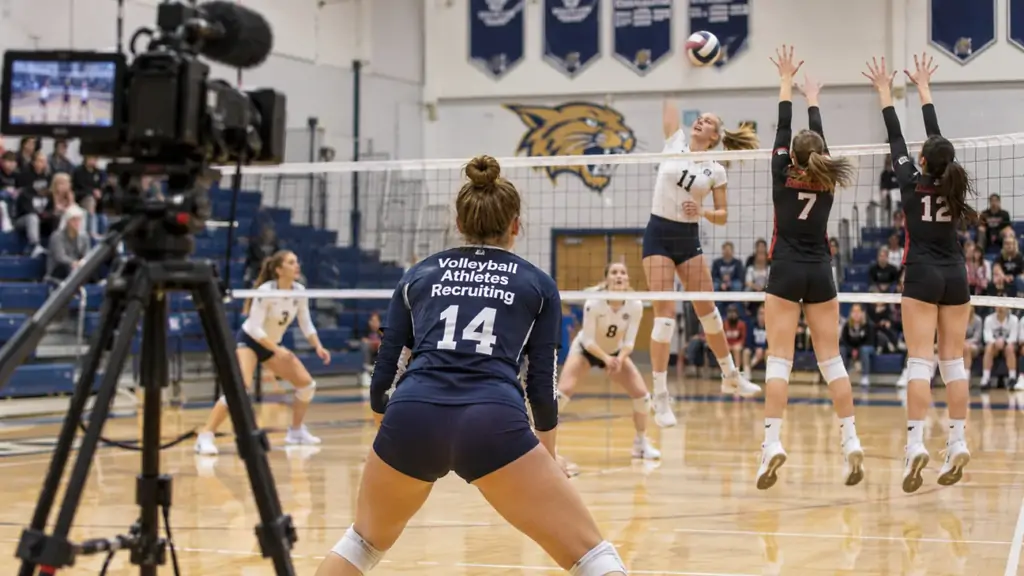
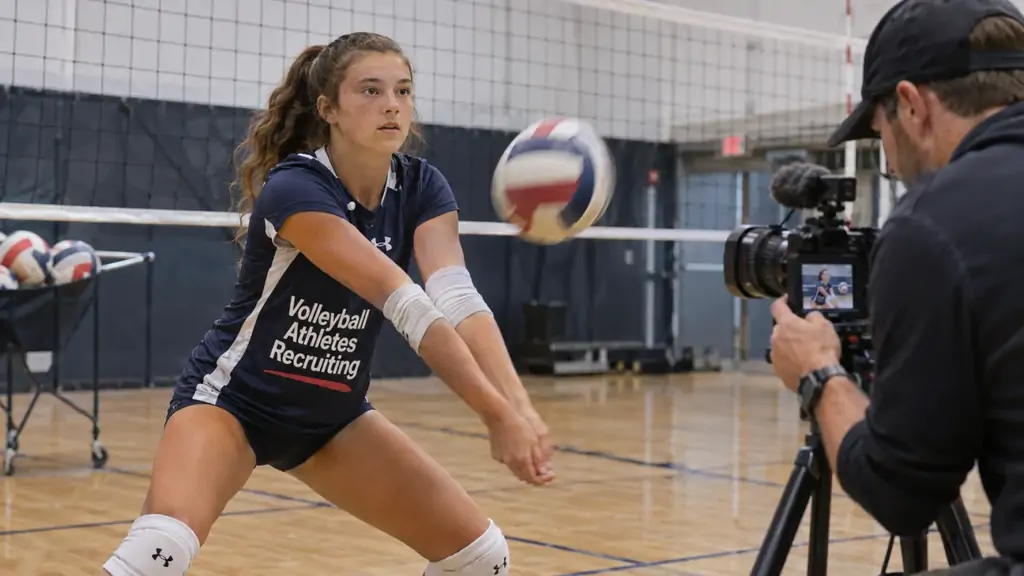
Good editing cannot fix footage that does not show enough of the court.
Whenever possible:
- Use a stable camera position
- Capture enough of the court to show movement and positioning
- Avoid excessive zooming
- Do not constantly follow only the ball
- Make sure the athlete can be identified
- Record in sufficient resolution for jersey numbers and movement to remain visible
A wider angle often gives coaches more information than a close-up because they can see what you do before and after you contact the ball.
Check your footage after the first match instead of discovering at the end of the tournament that the camera angle was unusable.
How to Use Your Recruiting Video in Coach Emails and Your Profile
Making the video is only half the job.
You need coaches to watch it.
Include the video in your recruiting profile and send that profile when contacting appropriate schools.
Your email should give the coach enough context to understand who you are:
- Name
- Graduation year
- Position
- Height
- Club/team
- Important academic information
- Recruiting-profile link
- Upcoming tournament schedule
Then make the video easy to find.
Our broader volleyball recruiting tips explain how video, coach emails, academics and follow-up should work together.
If you are managing the process yourself, also use our step-by-step guide on how to get recruited for college volleyball.
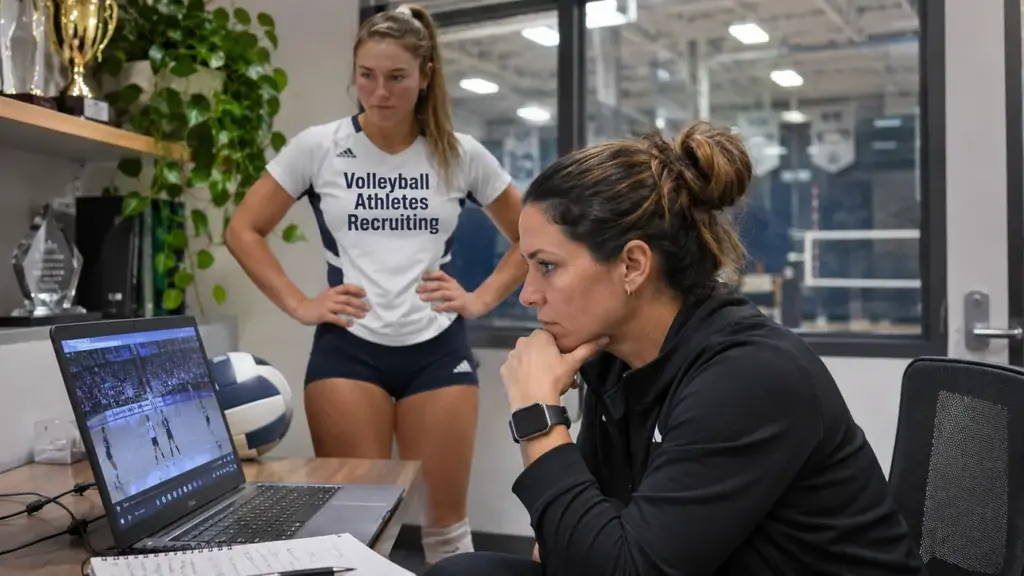
When Should You Update Your Volleyball Recruiting Video?
Do not create one recruiting video in Grade 10 and continue sending it two years later if your ability has significantly improved.
Update your video when you have meaningfully better footage.
Good opportunities include:
- After a major tournament
- After moving to a higher competitive level
- When your technical ability has clearly improved
- When you have better footage
- When coaches need to evaluate new skills
You do not need to rebuild the video every week.
The goal is to keep the material current enough that it accurately represents the athlete the coach would recruit today.
A new video also gives you a legitimate reason to follow up with coaches:
“Coach, I wanted to send you my updated recruiting video from this month’s tournament…”
That is much more useful than repeatedly emailing:
“Did you see my previous email?”
What Canadian Volleyball Athletes Should Keep in Mind
Your recruiting video is one part of a larger U.S. college recruiting strategy.
A strong video cannot compensate for targeting inappropriate schools, ignoring academics or failing to contact coaches.
Canadian athletes should build several realistic college options and continue updating coaches as their volleyball and academic profiles develop.
This is particularly important because recruiting conditions can change between the beginning of high school and college enrollment.
For example, H.R. 10351, the proposed TEAM USA Act, was introduced in the U.S. Congress on September 14, 2026. As introduced, it would limit international student-athletes to no more than 20% of each varsity roster at institutions participating in federal Title IV student-aid programs, beginning with the 2029–30 academic year.
The proposed 20% international-athlete limit is not current law and is not currently an NCAA recruiting rule. Canadian athletes should continue recruiting under the rules presently in effect while monitoring future developments if their expected college years could be affected.
You can read the official U.S. House Education and Workforce Committee announcement.
If scholarships are an important part of your college decision, read our complete guide on how to get a volleyball scholarship as a Canadian athlete.
Men’s athletes can also use our dedicated men’s college volleyball recruiting guide.
Frequently Asked Questions About Volleyball Recruiting Videos
How many clips should be in a volleyball highlight video?
There is no required number. Choose enough clips to demonstrate repeated, position-specific ability without adding weaker footage simply to increase the length. Quality and relevance matter more than reaching a specific clip count.
How long should a volleyball highlight video be?
Approximately 3–5 minutes is a practical target for an initial recruiting video. If you can demonstrate your skills effectively in less time, there is no need to make the video longer.
Can I send a full match instead of a highlight video?
You can provide full-match footage, but a short recruiting video makes initial evaluation easier. Ideally, have both available: a concise video for the first evaluation and full-game footage for coaches who want more context.
Should a volleyball recruiting video have music?
Music is unnecessary. Coaches are evaluating your volleyball ability, not video production. Keep the presentation simple so nothing distracts from the footage.
Should I use arrows or circles to identify myself?
A brief visual marker can help when the athlete is difficult to identify. Use it before the rally or momentarily at the beginning of the clip, then let the coach watch the play without unnecessary graphics.
Can I make my own volleyball recruiting video?
Yes. You do not need professional video production if your footage is clear, organized and easy for coaches to evaluate. The quality of the volleyball shown matters more than sophisticated editing.
Should I put serving first in my volleyball recruiting video?
Usually not. Begin with the most important skills for your position. Serving can be included later, but setters, hitters, middles and liberos all have position-specific skills that generally give coaches more useful information early in the evaluation.
Should I send my video before a volleyball showcase?
Yes, when you are contacting coaches who may attend the event. Sending your video, recruiting profile and schedule beforehand gives a coach an opportunity to evaluate you before deciding whether to watch you in person.
For more on event selection, read Are Volleyball Recruiting Showcases and Combines Worth It?
Final Thoughts: Make Your Volleyball Easy to Evaluate
The purpose of a recruiting video is not to prove that you are perfect.
It is to give college coaches enough useful information to decide whether they want to keep evaluating you.
Keep it concise. Show your strongest position-specific skills first. Use clear footage. Avoid unnecessary editing. Keep full matches available. And update your video as you improve.
Most importantly, do not leave the video sitting on YouTube and expect recruiting to happen automatically.
Connect it to your recruiting profile, send it to appropriate coaches and use it as part of a complete recruiting strategy.
If you want to manage recruiting yourself, start with our guide on how to get recruited for college volleyball.
If you want professional support with recruiting-video production, school targeting, coach outreach and the overall U.S. college recruiting process, learn more about our U.S. volleyball recruiting services for Canadian athletes.