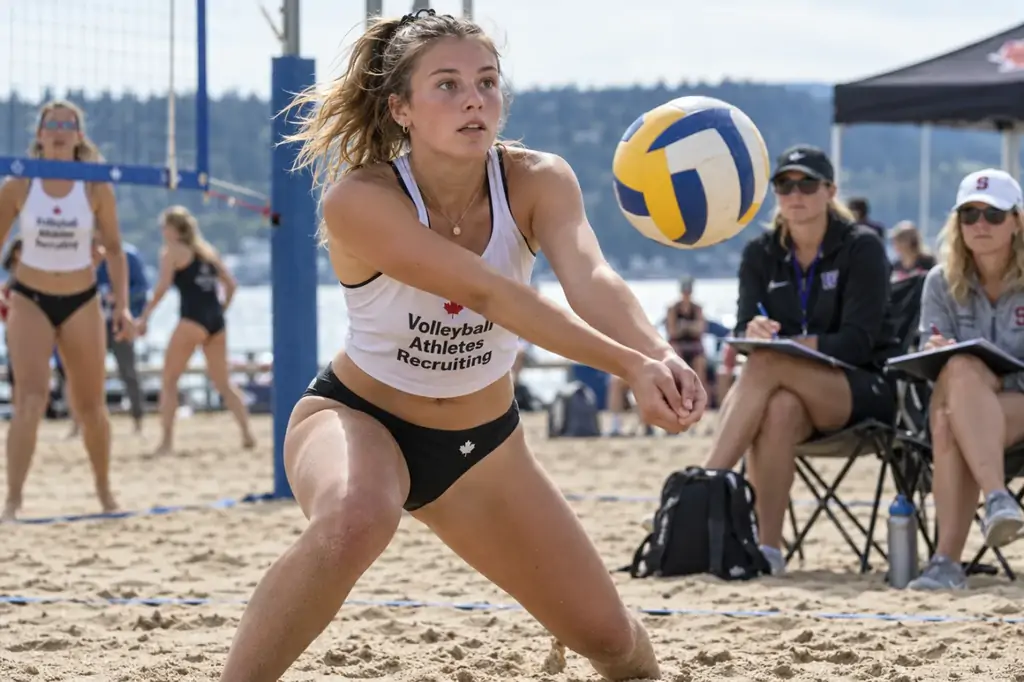
Getting recruited for college beach volleyball is different from simply playing well at tournaments and hoping a U.S. coach notices you.
Canadian beach volleyball athletes need to make themselves easy to evaluate. That means building a realistic school list, creating beach-specific recruiting video, sharing tournament results and schedules, contacting coaches directly and understanding the academic and eligibility requirements for U.S. college athletics.
Beach volleyball is also continuing to grow at the college level. NCAA women’s beach volleyball is an established championship sport, while the NAIA has approved women’s beach volleyball as a full championship sport beginning in 2027.
More opportunities, however, do not mean athletes should wait to be discovered. A proactive recruiting strategy can make a significant difference.
Article Summary
- Canadian beach volleyball athletes can be recruited by NCAA and NAIA programs in the United States.
- Beach recruiting requires beach-specific video, tournament history, academic information and direct communication with college coaches.
- Coaches may evaluate ball control, movement, attacking, serving, blocking or defence, decision-making, communication and overall development potential.
- Do not depend only on tournament results. Coaches need enough information and video to understand the level of competition and evaluate how you actually play.
- Division I women’s beach volleyball currently has a 19-player roster limit at schools operating under the House settlement rules, but a roster spot does not automatically mean a full scholarship.
- A proposed U.S. bill would limit international student-athletes to 20% of each varsity roster at covered institutions beginning in 2029–30 if enacted. As of September 2026, this is proposed legislation and is not current law.
In This Guide
- How College Beach Volleyball Recruiting Works
- How Beach Recruiting Is Different From Indoor Recruiting
- When Should You Start Beach Volleyball Recruiting?
- What Do College Beach Volleyball Coaches Look For?
- How to Make a Beach Volleyball Recruiting Video
- Build a Beach Volleyball Recruiting Profile
- How to Contact College Beach Volleyball Coaches
- Using Tournaments, Camps and Showcases
- How to Build a Realistic School List
- Beach Volleyball Scholarships and Financial Aid
- What Canadian Athletes Need to Know
- Possible Future International-Athlete Roster Limits
- Common Beach Volleyball Recruiting Mistakes
- Frequently Asked Questions
- Final Thoughts
How College Beach Volleyball Recruiting Works
College beach volleyball recruiting usually develops over time.
A coach may first learn about an athlete through an email, recruiting profile, tournament, club coach, video, camp or showcase. From there, the coach may follow future results, request additional video, review academics and determine whether the athlete fits an upcoming roster need.
That means your goal should not simply be to get “seen.”
Your goal is to give appropriate college coaches enough information to decide whether they want to continue evaluating you.
Canadian athletes who are new to the overall process should also read our complete guide on how to get recruited for college volleyball.
How Beach Volleyball Recruiting Is Different From Indoor Recruiting
Indoor volleyball experience can be valuable, but beach volleyball gives coaches a different view of an athlete.
With only two athletes on the court, players have much more responsibility in every rally.
A beach athlete may need to serve, pass, set, attack, defend, communicate and make tactical decisions repeatedly. There is less opportunity to hide a weakness behind specialized rotations or substitutions.
That makes beach-specific footage important.
An athlete who has excellent indoor video should not assume it is enough for a beach volleyball coach. Indoor experience may support your athletic profile, but a beach coach still needs to evaluate how you move, make decisions and execute beach skills on sand.
Your tournament history is also useful, but results need context. A finish at one event may mean something very different from the same finish at another level of competition.
When Should You Start Beach Volleyball Recruiting?
Start learning and preparing before you feel pressure to make a college decision.
Early preparation can include:
- Researching U.S. college beach programs
- Understanding different athletic levels
- Keeping your tournament results organized
- Collecting clear beach-specific video
- Building your academic record
- Creating a recruiting profile
As your level develops, you can narrow your school list and begin more targeted coach communication.
Starting early does not mean emailing every college coach immediately. It means making sure you have the information and materials you need when recruiting becomes active.
What Do College Beach Volleyball Coaches Look For?
There is no single measurement or tournament result that determines whether an athlete can play college beach volleyball.
Coaches may evaluate:
- Ball control
- Serve receive
- Setting
- Attacking range
- Serving pressure and consistency
- Blocking or defensive ability
- Movement on sand
- Decision-making
- Communication with a partner
- Competitive level
- Physical development
- Academic fit
- Potential for improvement
Tournament Results and Level of Competition
Strong tournament results can help establish your competitive level, but a coach will normally want more context.
Who did you compete against? What level was the tournament? What role did you play in the partnership? How consistently are you performing?
Keep a clear record of important tournament results, but do not make rankings and medals your entire recruiting profile.
Physical Profile and Development Potential
Height, reach, speed and jumping ability can influence how a coach sees your future role, but there is no universal physical profile that guarantees recruitment.
Beach volleyball also rewards movement, ball control, reading the game, versatility and decision-making.
Coaches are recruiting the complete athlete, not one measurement.
How to Make a Beach Volleyball Recruiting Video
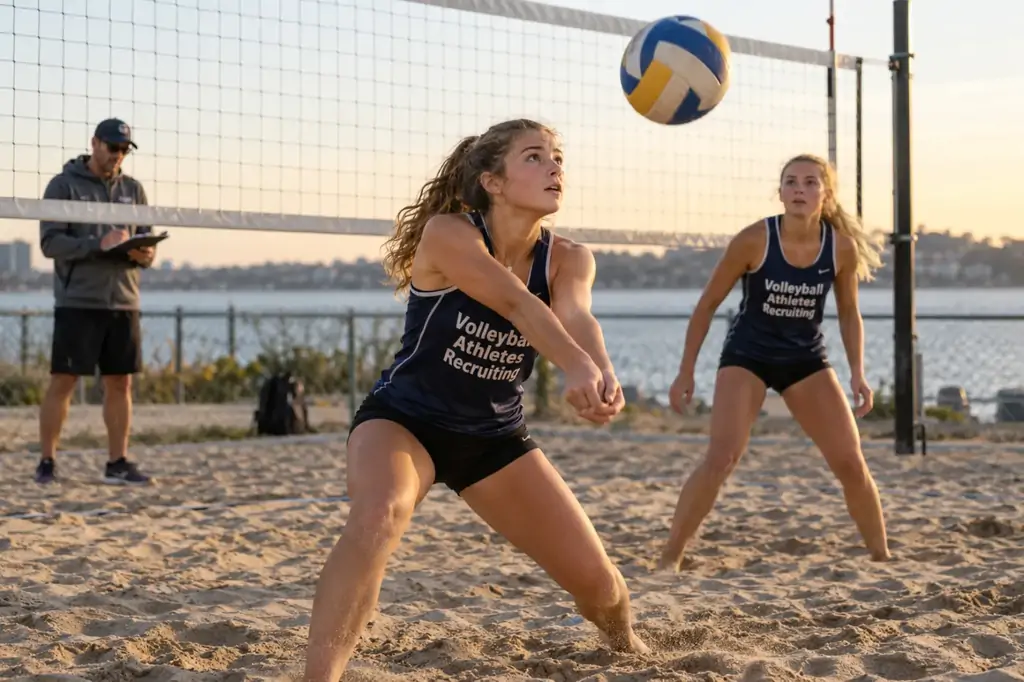
Beach recruiting video should show coaches how you actually play beach volleyball.
Include rallies that demonstrate several parts of your game rather than only attacks or highlight moments.
Depending on your style and role, useful footage may show:
- Serve receive
- Setting
- Attacking
- Serving
- Blocking
- Defence
- Transition play
- Out-of-system rallies
- Decision-making under pressure
Identify yourself clearly and avoid long introductions or distracting editing.
Coaches may also want complete sets or matches so they can evaluate how you perform between the best clips.
For detailed recommendations on video length, clip order and editing, use our guide on how to make a volleyball recruiting video.
Build a Beach Volleyball Recruiting Profile
Your recruiting profile should make the coach’s job easier.
Include important information such as:
- Name and graduation year
- Height and relevant measurements
- Beach and indoor volleyball experience
- Important tournament results
- Upcoming tournament schedule
- Recruiting video
- Academic information
- Contact details
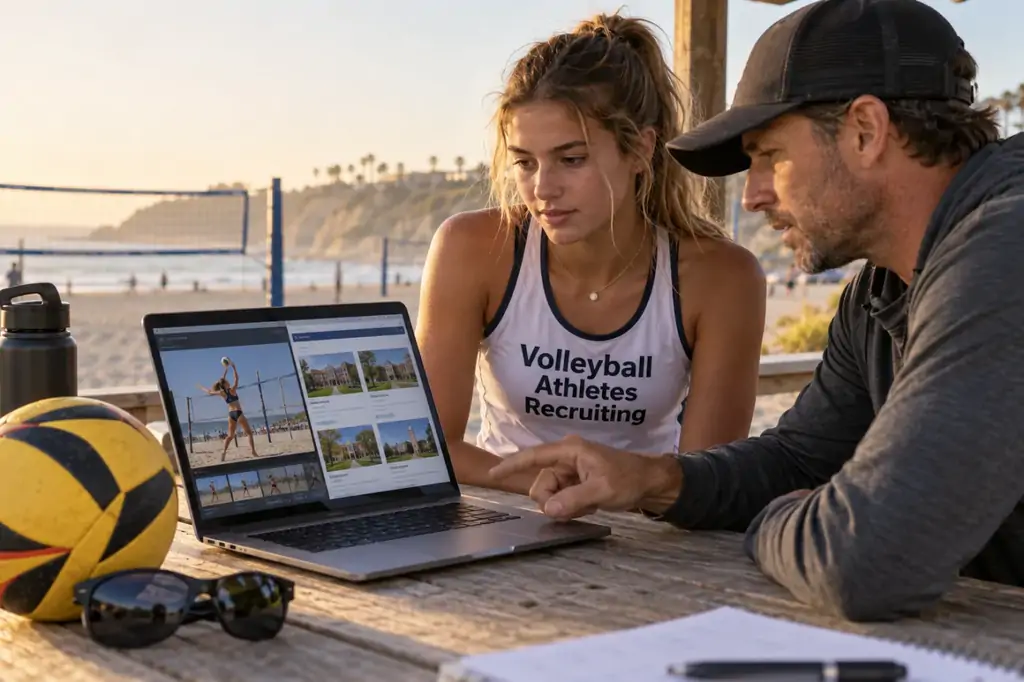
A volleyball recruiting profile allows you to keep this information together on one page that can be shared directly with coaches.
Keep it updated. A coach opening your profile months after your first email should still see your current video, results and schedule.
How to Contact College Beach Volleyball Coaches
Do not wait for every coach to discover you at a tournament.
Identify programs that fit your level and contact those coaches directly.
Your email should be concise and contain enough information for a coach to decide whether to learn more.
Include:
- Your name
- Graduation year
- Height
- Beach volleyball experience
- Important recent results
- Academic information
- Recruiting profile
- Video link
- Upcoming tournament schedule
Avoid sending the same generic message to hundreds of programs.
Targeted communication to realistic programs is more useful than simply maximizing the number of emails sent.
How to Use Beach Tournaments, Camps and Showcases for Recruiting
Tournaments can become valuable recruiting opportunities when college coaches already know you will be there.
Before an important event, contact relevant programs and provide your schedule, location and recruiting-profile link when available.
If a college offers a beach camp, investigate whether the program is genuinely a realistic target before investing in registration and travel.
The same principle applies to recruiting showcases.
Ask which programs are expected to attend and whether those schools fit your recruiting level.
Our guide on whether volleyball recruiting showcases and combines are worth it provides a framework for evaluating these events.
How to Build a Realistic College Beach Volleyball School List
Do not select schools based only on rankings or recognizable names.
Your college list should consider:
- Your current and projected volleyball level
- Academic requirements
- Available majors
- Location
- Total cost
- Financial aid
- Team roster
- Graduation years of current athletes
- Coaching staff
- Program culture
Look at the roster carefully.
If a program already has several younger athletes with similar profiles, that may affect its recruiting needs. Another program may be actively looking for exactly your type of player.
Your school list should also include more than one level of program. Recruiting becomes much riskier when an athlete depends on interest from only one or two highly selective schools.
Beach Volleyball Scholarships and Financial Aid
Scholarship rules depend on the division and institution.
At NCAA Division I institutions covered by or opting into the House settlement, women’s beach volleyball currently has a 19-athlete roster limit. Those programs are no longer restricted by the former sport-specific scholarship cap and may offer athletic scholarships across the roster.
However, schools are not required to provide a full scholarship to every rostered athlete. Funding decisions still depend on the institution and program.
NCAA Division II women’s beach volleyball currently operates under an equivalency system with up to 5.0 athletic scholarship equivalencies, which coaches may divide among multiple athletes.
NCAA Division III does not award athletic scholarships, although athletes may receive academic, merit-based and need-based aid.
The NAIA also sponsors women’s beach volleyball. In August 2026, the NAIA approved beach volleyball as its 31st championship sport beginning with the 2027 season, further expanding the college pathway available to athletes.
For a full explanation of the different systems, read our guide on how to get a volleyball scholarship as a Canadian athlete.
What Canadian Beach Volleyball Players Need to Know About U.S. Eligibility
Being recruited is only one part of becoming a U.S. college athlete.
Canadian athletes targeting NCAA programs must also meet the appropriate academic and athletics eligibility requirements.
International students planning to compete in NCAA Division I or Division II generally need academic and athletics certification through the NCAA Eligibility Center. International Division III athletes generally need athletics certification.
The NCAA provides specific academic guidance for Canadian provinces through its international student-athlete eligibility resources.
Do not wait until you receive an offer before learning about eligibility requirements. Your academic planning should develop alongside your recruiting strategy.
Could Future International-Athlete Limits Affect Canadian Beach Volleyball Players?
Canadian athletes whose college years may begin in 2029 or later should also be aware of a proposed U.S. law that could affect future international recruiting.
On September 14, 2026, lawmakers introduced H.R. 10351, the Training and Education for American Members in University Sports and Athletics Act (TEAM USA Act).
The proposal would require U.S. colleges and universities participating in federal Title IV student-aid programs to limit international student-athletes to no more than 20% of each varsity team’s roster. The proposed requirement would take effect beginning with the 2029–30 academic year.
This is proposed legislation and is not current law. The current NCAA rules do not impose this proposed 20% international-athlete limit.
Canadian athletes should therefore continue recruiting based on the rules currently in force while monitoring the proposal if their expected college entry date could fall within the proposed implementation period.
You can review the official U.S. House Education and Workforce Committee announcement.
This is also another reason to avoid depending on only one or two schools. A broad, realistic recruiting list helps protect an athlete against future changes in roster needs, coaching staff, scholarship budgets or recruiting rules.
Common Beach Volleyball Recruiting Mistakes
Waiting to Be Discovered at Tournaments
Competing at strong events is useful, but coaches need to know who you are and where you will be playing.
Sending Only Indoor Volleyball Video
Indoor experience can support your profile, but beach coaches need to evaluate beach-specific skills and movement.
Choosing Schools Only by Reputation
The most recognizable beach program is not automatically the best recruiting opportunity for you.
Sending Video Without Context
Give coaches your graduation year, academics, tournament history, upcoming schedule and recruiting profile along with the video.
Ignoring Academics
Your recruiting list must also be an academic list. A coach cannot solve every admissions or eligibility issue.
Starting Too Late
College programs recruit based on future roster needs. Waiting until your options become urgent can leave fewer programs with available space.
Frequently Asked Questions About College Beach Volleyball Recruiting
Can Canadian athletes play NCAA beach volleyball?
Yes. Canadian athletes can compete for NCAA programs if they are recruited, admitted to the institution and meet the applicable NCAA eligibility requirements.
Do college beach volleyball players get scholarships?
Athletic scholarships are available at some NCAA and NAIA programs, but the amount varies by division, institution, program funding and recruiting need. Division III schools do not provide athletic scholarships.
Do I need to play indoor volleyball to get recruited for beach volleyball?
No. Indoor experience can help develop useful volleyball skills, but college beach coaches need to evaluate your beach-specific ability. Your recruiting materials should show how you perform on sand.
Should my beach volleyball recruiting video include full matches?
A concise recruiting video can help a coach make an initial evaluation, while complete sets or matches provide additional context. It is useful to have both available.
Do I need a recruiting agency for college beach volleyball?
No. Families can research programs, create recruiting materials and contact coaches themselves. Professional recruiting support can be useful for families who want help with school targeting, coach outreach and managing the overall process.
Can I be recruited for both indoor and beach volleyball?
Yes, athletes can have experience and recruiting interest in both sports. However, your communication with each coach should make it clear which college program you are targeting and provide the relevant video and competitive history for that sport.
Final Thoughts: Make It Easy for Beach Volleyball Coaches to Evaluate You
College beach volleyball recruiting is not just about having great tournament results.
You need to help the right coaches understand who you are, how you play, where you fit and why you could help their program.
Build your school list carefully. Keep your video and profile current. Contact coaches directly. Use tournaments and showcases strategically. And develop several realistic options rather than depending on one school.
Families who prefer to manage the process independently can use our broader guide to getting recruited for college volleyball.
If you want professional help with school targeting, coach outreach, recruiting video, profiles and scholarship opportunities, learn more about our NCAA Beach Volleyball Recruiting Services for Canadian athletes.