
Summary
Winnipeg’s men’s volleyball team travelled to Langley on November 13 and 14 and defeated nationally top-ranked Trinity Western twice, winning 3-1 and 3-2. Levi Unger’s attacking drew attention, but blocking, adaptability and composure also mattered. Young athletes hoping to play university volleyball can learn plenty from the two different wins.
Winnipeg takes down the top-ranked Spartans
Beating the country’s No. 1 team once is a big result. Doing it twice in the same weekend, in its home gym, makes people pay attention.
On Friday, November 13, Winnipeg won 25-15, 25-21, 23-25 and 25-23. Outside hitter Levi Unger delivered 23 kills, and the Wesmen recorded 12 team blocks against Trinity Western’s six.
Saturday was more complicated. Winnipeg dropped the second and third sets, then responded to win the fourth 25-21 and the fifth 15-13. Unger finished with another 20 kills, and Winnipeg moved to 5-1 in Canada West play.
Sources: University of Winnipeg, Friday recap and Saturday recap.
What made the difference?
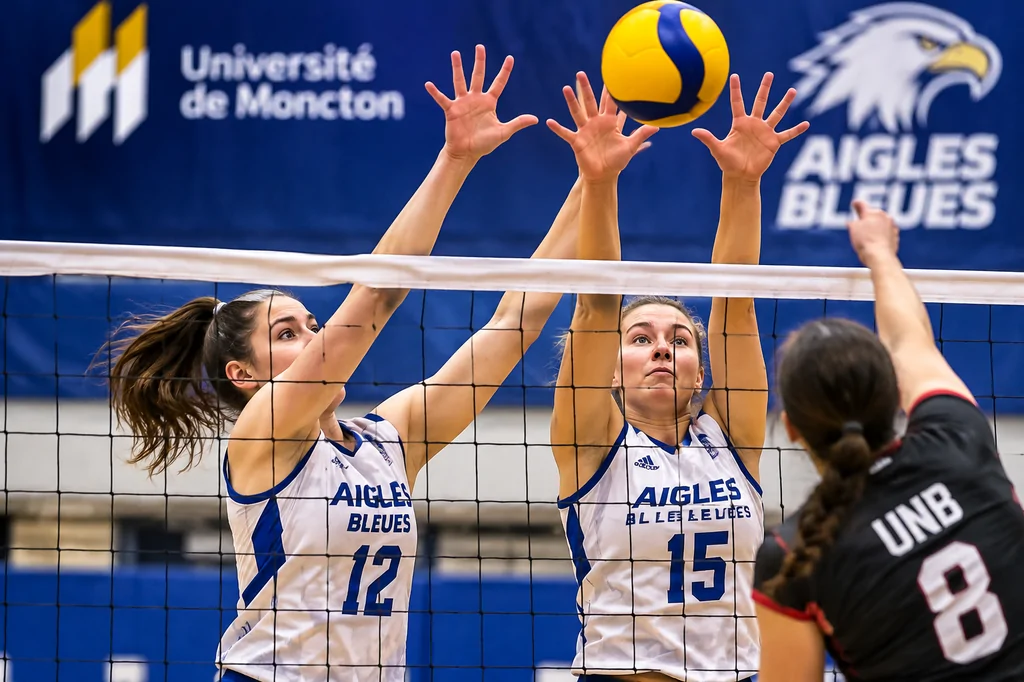
Friday’s blocking numbers tell part of the story. A strong block changes how a hitter sees the court and gives the defence better opportunities to keep rallies alive. Unger was excellent offensively, but this wasn’t a result built on one player alone.
Saturday tested something else. Trailing two sets to one, Winnipeg needed adjustments and steady execution. The Wesmen held Trinity Western to a negative hitting percentage in the fourth set before taking the deciding fifth.
Good university teams need more than one way to win. Some nights the attack is flowing. Other nights they need to serve tougher, defend longer and make fewer errors late in sets.
What recruiting coaches can learn from matches like this
A 23-kill performance naturally attracts attention. But coaches evaluating a potential recruit want to know how the points were earned. Could the hitter score against a well-formed block? Handle a difficult set? Stay effective when an opponent changed its defence?
The same questions apply to other positions. A setter’s choice late in a fifth set, a middle’s block read or a libero’s controlled first pass can be as revealing as a spectacular attack.
Quality of opposition matters too. Similar statistics against very different opponents do not necessarily show the same competitive level. Coaches need the match context as well as the numbers.
How young athletes can apply those lessons
Keep footage from your best performances against strong opponents, especially complete sets. That lets coaches see your passing, defence, transition play, communication and responses to mistakes rather than only your top highlights.
Make your video specific to your role. Setters should show decision-making, liberos should show serve receive and reading the attack, and middles should include blocking movement and their availability in transition.
Our volleyball recruiting video guide explains how to organize footage. Canadian boys exploring university options can also use the men’s college volleyball recruiting guide.
Winning against a top-ranked team isn’t a requirement to be recruited. Being able to contribute reliably as the competition gets harder is what matters.
FAQs
Does playing against ranked teams improve recruiting opportunities?
It can provide valuable evidence of an athlete’s level when coaches can review the performance. It does not automatically generate recruitment.
Should recruiting videos include difficult matches?
Yes. Full sets against challenging opponents can show adaptability and consistency that highlights miss.
Do coaches evaluate more than individual statistics?
Yes. Technique, game decisions, team responsibilities, academics and development potential all matter.
Can Canadian boys pursue both U SPORTS and NCAA volleyball?
Yes, subject to each institution’s admission and athletic eligibility rules. Programs and financial arrangements differ.